Recap of the Third Parent Workshop
16 十一月, 2026
When Kids Become the CEOs of "AI Companies"
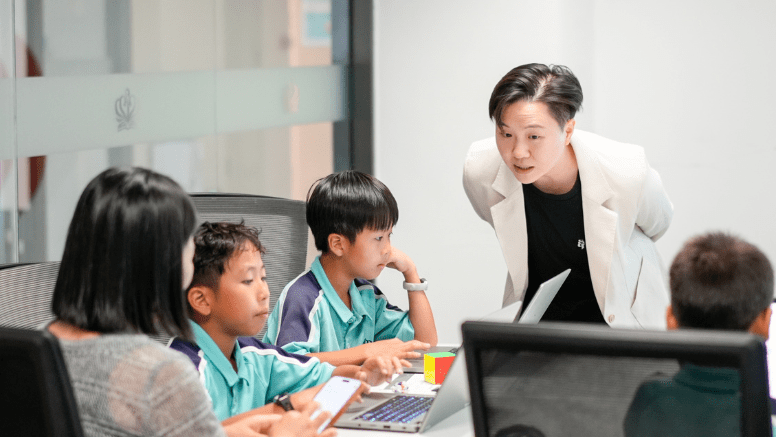
AI Company
In this parent academy, we invited Ms. Pang Nan, co-founder of Riki AI, to explore with parents and children how to cultivate children's AI quotient (AIQ) in the age of AI.
First Half | A One-Hour Sharing Session — Parents Said "Our Kids Should Hear This Too"
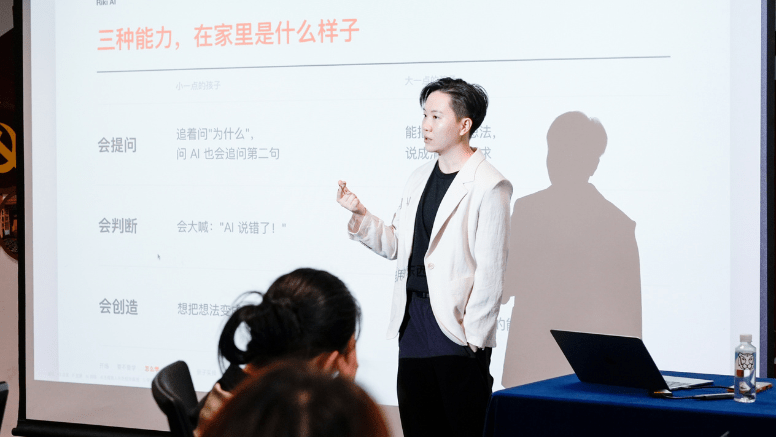
We are all familiar with IQ and EQ, and have also heard of FQ (financial quotient). But in the AI era, what sets people apart is "AIQ": it's not about whether you can use a particular AI software, but about understanding AI, being able to judge AI, and making AI work for you.
"AIQ" = Knowing how to ask questions × Knowing how to judge × Knowing how to create:
- Knowing how to ask questions: The barrier to producing things has disappeared, but the barrier to thinking things through has risen. Only by thinking clearly about what you want and why you're doing it can AI truly help.
- Knowing how to judge: AI is not omnipotent. It makes mistakes, doesn't know your child, and cannot think on behalf of your child. Without clear thinking and judgment, having AI will only lead to mass-producing "AI SLOP."
- Knowing how to create: In the past, the key was doing well on exams; in the future, the key is being able to create — identifying a real problem and using AI to bring it to life.
Ms. Pang Nan also shared changes she observed on the front lines: more and more children have already started using AI to solve real problems around them and create works of their own. After the sharing, many parents told us that this one hour was extremely valuable — especially the content about "AI is not omnipotent" and the "Family AI Usage Pact" — and felt that their children should also hear it.
Second Half | Starting a "Family AI Company" and Building a Playable Mini-Game Hands-On
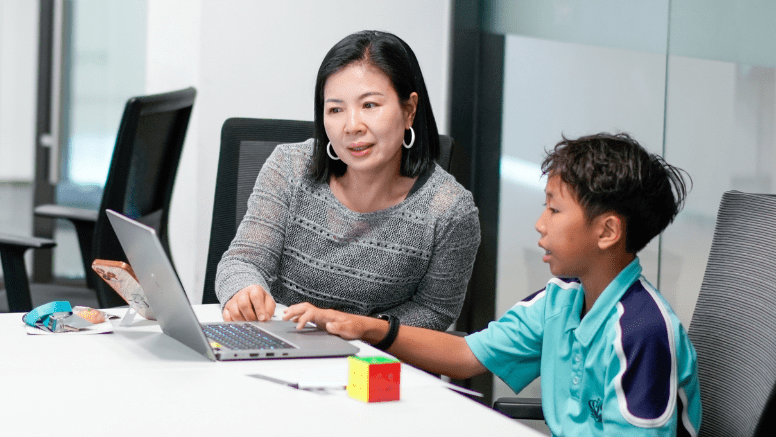
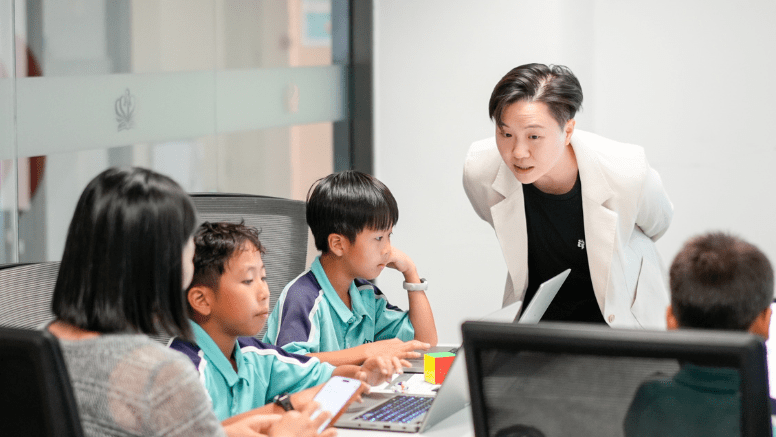
After the students joined, each family established their own company, with the goal of using AI to build a learning mini-game that could be played right away:
👧 The child is the CEO, responsible for making decisions
👨👩👧 Parents are partners, helping with typing and offering ideas
🤖 AI is the employee, responsible for doing the work
From holding company meetings and assigning tasks to AI, to the CEO accepting deliverables and the company opening for business, the atmosphere on site was incredibly lively. By the end of the event, many children were still unwilling to go home even at 5 PM.
One student made a "Chemical Elements Matching Game," where Chinese names and English names of elements had to be paired up. The parent partner helped with typing, but the prompts were all her own ideas. She specifically instructed AI that during the matching process, it must double-check and triple-check. No one taught her to say this — she figured out on her own that AI often makes mistakes.
Another student had very clear ideas of his own. He clearly told AI what kind of game he wanted, asked AI to search online for examples of that type of game, learn from them, and then follow suit. He kept watching every step of AI's work and even pointed at the screen to tell the teacher: "Look, it knows on its own that it can search online!"
A Grade 1 student made a 24-point game. The game was built, but at first he didn't even know how to play it himself. Addition, subtraction, multiplication, and division still require some calculation for a first-grader, so he and his mom huddled together, working out one problem at a time how to make 24. The process of making the game also became a process of learning.
What Were Parents Discussing?
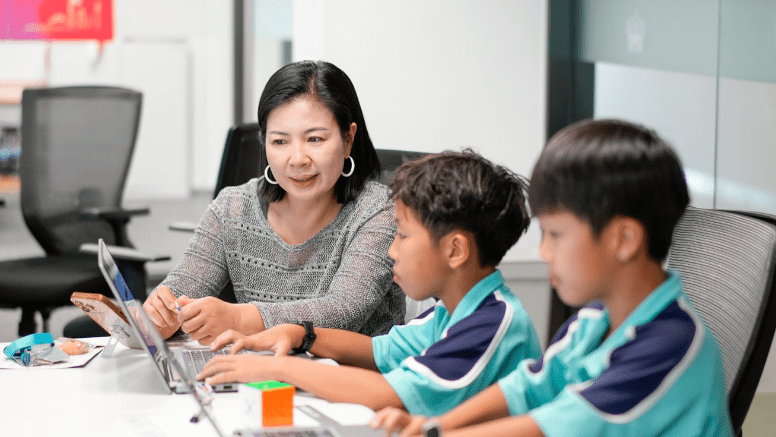
Ms. Pang Nan taught the students how to give instructions to their AI employees: first clarify AI's identity, then explain the goals, rules, and requirements. Many parent partners were particularly interested in this and asked quite a few questions: Why write it this way? What is the purpose of each sentence? In the future, when children converse with AI and assign tasks to AI, can they use the same thinking framework? During the discussion, many parents shared the same feeling: collaborating with AI actually tests children's overall framework and logical thinking.
Each family's task card also had a section called "Company Charter: Our Family's 3 Rules for Using AI." Parents were full of curiosity about this Family AI Usage Pact, discussing how to write it and how to guide children to set their own rules. The "whys" that children come up with are the beginning of AI literacy. During the game-making process, children asked questions one after another:
- Why does my game not start when I click start?
- Why is the game I made different from the teacher's?
- Why do I need to tell AI at the beginning: "You are our company's game development employee"?
- How can I get other people to play my game too?
...
Every "why" is a child learning to observe, question, and judge. They begin to understand: what AI produces must be tested and checked by yourself; the same idea, expressed differently, leads to different results; only by clearly stating identity and goals can AI understand you better; and once a work is created, you want others to be able to play it too.
We found that no matter what grade the children are in, as long as they leverage AI's capabilities, they can turn their imagination into a small work that is playable, shareable, and helpful for learning. More importantly, they learned to reflect during the process.
Closing Thoughts
Under the broad trend of AI development, we hope children will not only know how to use AI, but also be able to think independently about AI and distinguish good from bad.
Cultivating AI literacy is a direction our school has always valued and encouraged. Thank you to every parent partner who came, and thank you to the children — with your creativity and passion, you have shown us unlimited potential.
本次家长课堂,我们邀请Riki AI联合创始人庞楠老师,和家长、孩子们一起探索AI 时代如何培养孩子的 AI 商。
上半场|一小时的分享,家长们说“孩子也该来听”
我们熟悉智商、情商,也听过财商。但在AI 时代,拉开差距的是“AI 商”:不是会不会用某个 AI 软件,而是懂 AI、会判断 AI、能让 AI 为自己工作。
“AI 商”= 会提问 × 会判断 × 会创造:
- l会提问:做出来的门槛没了,想清楚的门槛变高了。想清楚要什么、为什么做,才能让 AI 真正帮上忙。
- l会判断: AI 不是万能的。它会出错,不了解你的孩子,也不能替孩子思考。想不清楚、没有判断力,有了 AI 也只能批量生产“垃圾”。
- l会创造:过去拼会考试,未来拼会创造:发现一个真实的问题,用 AI 把它做出来。
庞楠老师还分享了自己在一线看到的变化:越来越多的孩子已经开始用 AI 解决身边真实的问题,做出属于自己的作品。讲座结束后,很多家长告诉我们,这一个小时非常有价值,尤其是“AI 不是万能的”、“家庭 AI 使用公约”这些内容,觉得孩子们也应该来听一听。
下半场|开一家「家庭 AI 公司」,亲手做一款能玩的小游戏
学生入场后,每个家庭都成立了自己的公司,目标是用 AI 亲手做一款马上就能玩的学习小游戏:
👧孩子是 CEO,负责拿主意
👨👩家长是合伙人,帮忙打字、出主意
🤖 AI 是员工,负责干活
从开公司会、给 AI 派活,到 CEO 验收、公司开张,现场气氛非常热烈。活动结束时,不少孩子到了5点还不愿意回家。
有一位同学做了“化学元素翻翻乐”,要把元素的中文名和英文名两两配对。家长合伙人帮忙打字,但提示词是她自己想的。她特别叮嘱 AI,配对的过程中,一定要再三检查。没有人教她这样说,是她自己想明白了AI 经常出错。
还有一位同学很有自己的想法。他清楚地告诉 AI 自己想要什么样的游戏,让 AI 去网上找这种游戏的样式,学习之后再照着做。他一直盯着 AI 工作的每一步,还指着屏幕告诉老师:“你看,它自己知道可以去网上搜!”。
一位一年级同学做了一个24点游戏,游戏做出来了,他自己一开始却还不会玩。加减乘除对一年级的孩子来说还要算一算,于是他和妈妈凑在一起,一题一题地算怎么凑出 24。做游戏的过程,也成了学习的过程。
家长们在讨论什么?
课上,老师教了孩子怎么给 AI 员工下达指令:先说清楚 AI 的身份,再讲目标、规则和要求。很多家长合伙人对此特别感兴趣,问了不少问题:为什么要这样写?每一句的目的是什么?以后孩子和 AI 对话、给 AI 布置任务,是不是也可以用同样的思维框架?讨论中,不少家长也有同感:和 AI 协作,考验的其实是孩子整体思维的框架性和逻辑性。
每个家庭的任务卡上还有一栏「公司章程:我们家用AI的3条约定」。家长们对这份家庭AI使用公约充满好奇,讨论该怎么写、怎么引导孩子自己定规矩。孩子们冒出来的“为什么”,就是 AI 素养的开始。做游戏的过程中,孩子们一点一点地发问:
- 为什么我的游戏点了开始,却开始不了?
- 为什么我做的游戏,跟老师做的不一样?
- 为什么开头要告诉 AI:“你是我们公司的游戏开发员工”?
- 我要怎么让别人也玩上我的游戏?……
每一个“为什么”,都是孩子在学着观察、提问、判断。他们开始明白:AI做出来的东西,要自己试、自己检查;同样的想法,说法不一样,结果就不一样;把身份和目标说清楚,AI 才更懂你;作品做出来了,还想让别人也玩一玩。
我们发现,无论几年级的孩子,只要借助 AI 的能力,都能把自己的想象力变成一个能玩、能分享、能帮助学习的小作品。 更重要的是,他们在过程中学会了反思。
在AI发展的大趋势下,我们希望孩子不只是会用 AI,更能对 AI 独立思考、分辨好坏。
AI素养的培养,是我们学校一直重视和鼓励的方向。感谢每一位家长合伙人的到来,感谢孩子们,用他们的创造力和热情,让我们看到了无限的潜力。